
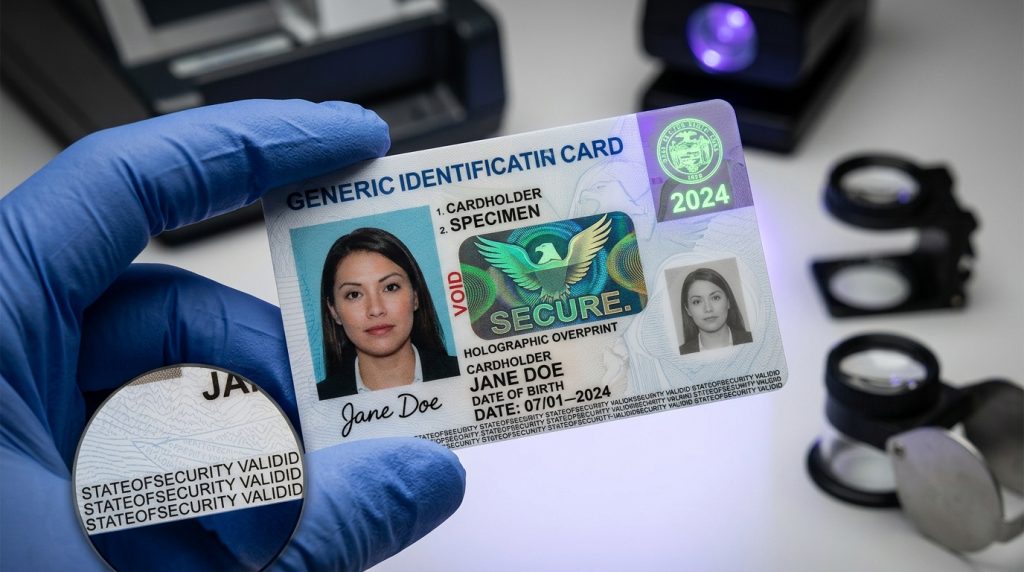
In an era of high-definition printing and sophisticated digital tools, the ability to distinguish between a standard novelty item and a professional-grade document has become a technical skill. Whether for educational purposes, film production, or security training, understanding the physical and chemical properties of a document is essential. To maintain high standards, one must know exactly how to identify high-quality ID security features through a combination of tactile, visual, and electronic inspections.
1. Tactile Integrity and Laser Engraving
The first test of a high-quality document is not visual, but tactile. Modern identification cards have moved away from simple PVC to Polycarbonate (PC) materials. When layers of polycarbonate are fused under high heat, they create a “clinking” sound when dropped on a hard surface, similar to a CD or a piece of glass.
A primary feature to look for is Laser Engraved Tactile Text. High-quality vendors use laser technology to burn data directly into the core of the card. This results in raised lettering (such as the birth date or signature) that you can feel with your thumb. If the text is perfectly flat or feels like it was merely printed on the surface, it lacks the industrial-grade craftsmanship required for true authenticity.
2. Optically Variable Elements
The “shifting” nature of a card’s surface is its most difficult feature to replicate. Professionals look for Optically Variable Ink (OVI) and Diffractive Optically Variable Image Devices (DOVIDs).
- OVI: This ink changes color depending on the angle of the light. A high-quality feature will show a distinct, crisp transition (e.g., from green to gold) rather than a muddy or static shimmer.
- Holographic Overlays: Rather than a generic “shield” or “globe” pattern, a professional document uses custom-designed transparent holograms that are embedded beneath the laminate, ensuring they do not peel or scratch off.
3. Microprinting and Fine-Line Patterns
To the naked eye, a document might look perfect, but a jeweler’s loupe reveals the truth. High-quality security features include Microprinting—text so small it appears as a solid line to the human eye. Under magnification, this line should reveal clear, legible characters without any “bleeding” or ink splatter. Similarly, “Guilloche” patterns (complex, thin-line geometric designs) should be continuous and unbroken, a feat that consumer-grade printers cannot achieve.
4. Specialized Educational Resources
For those looking to deepen their understanding of these complex systems, staying updated on industry shifts is vital. Many enthusiasts and security professionals refer to the idgod security education guides to learn about the latest iterations of UV fluorescence and ghost image techniques. These resources provide a benchmark for what constitutes “state-of-the-art” in the novelty document space.
5. Ultraviolet (UV) Fluorescence
Finally, the “hidden” layer of a card is its UV response. A high-quality document does not just “glow” under a blacklight; it reveals multi-colored, high-resolution imagery that is invisible in daylight. The UV ink should be “dead,” meaning the card itself shouldn’t glow blue (as standard paper or cheap plastic does), but the specific security icons should pop with vibrant, distinct colors.
Conclusion
Knowing how to identify high-quality ID security features requires an eye for detail and an understanding of industrial manufacturing. By focusing on the “Triple-Check” method—Touch, Tilt, and Tools—you can ensure that you are dealing with a product that meets the highest standards of modern replication and security education.
