
Editor’s note: This article is an informational overview of online communities that discuss peptides. It is not medical advice, and it is not an endorsement or promotion of any product, vendor, or protocol. Peptides, including many of the “research” compounds discussed in these communities, are not all FDA-approved for human use, and several remain in unresolved regulatory territory as of 2026. If you are considering any peptide therapy, prescription or otherwise, talk to a licensed physician first. This piece is written for adult readers who want to understand the landscape of discussion, not a how-to guide. Reader discretion is advised.
Key Takeaways
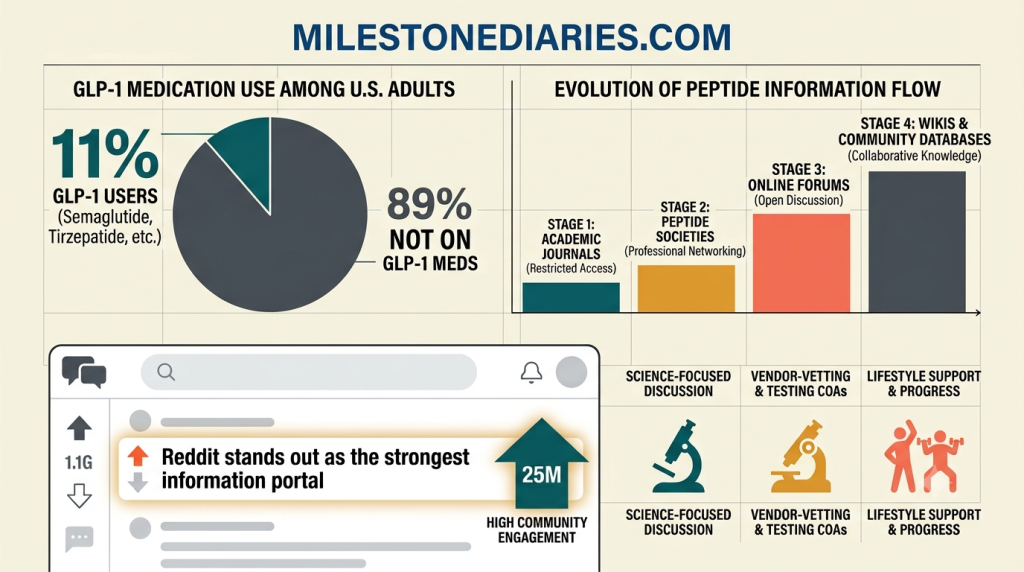
- Peptide use has gone mainstream, but transparency hasn’t kept up, with ~11% of U.S. adults now on GLP-1 medications and many turning to less-regulated research peptides, forums fill the honest, real-world information gap that vendors rarely provide.
- The conversation evolved from closed science to open crowds, from academic peptide societies and journals to today’s sprawling online forum and wiki ecosystem, largely driven by peptides moving from niche to mainstream.
- Reddit stands out as the strongest information portal, its voting system, specialized subreddits, and stricter anti-promotion moderation make it more resistant to marketer exaggeration than most standalone forums, even though some hype still slips through.
- Not all peptide forums serve the same purpose, and none replace a doctor, they range from science-focused to sourcing/vendor-vetting to lifestyle support, so use them to inform questions and spot red flags, but verify anything important with a licensed physician.
Why This Peptide Forum Conversation Matters in 2026?
If you had asked a dermatologist, endocrinologist, or sports medicine doctor about “peptides” ten years ago, most patients would have had no idea what they meant. That’s no longer true. Peptide therapy everything from GLP-1 receptor agonists for weight loss to smaller research compounds like BPC-157, TB-500, and Semax for recovery, cognition, and longevity has become one of the most talked-about categories in American health and wellness.
The numbers back this up. A Gallup poll released in July 2026 found that roughly 11% of U.S. adults are currently taking a GLP-1 medication for weight loss, up from just 3% in 2024 with 15% saying they've used one at some point. Public awareness of GLP-1 drugs has climbed to 91%, up from 80% just two years earlier.
That same survey found a meaningful split in how people are getting these medications: about 68% are using brand-name products like Ozempic, Wegovy, Mounjaro, or Zepbound, while roughly 19% are using compounded or custom-mixed versions often because of cost or insurance coverage. Separately, CDC data has tracked more than a 500% increase in GLP-1 spending between 2018 and 2023, and a 155% jump in the share of people with type 2 diabetes using GLP-1 injectables over roughly the same window.
That's just the FDA-approved side of the peptide world. Sitting alongside it is a much murkier, much less regulated category: research peptides like BPC-157, TB-500, MOTS-c, GHK-Cu, Melanotan II, Semax, Epitalon, and dozens of others, most of which are sold labeled "for research use only, not for human consumption," yet are used by a large and growing number of people off-label. In 2026, the FDA's Pharmacy Compounding Advisory Committee has been actively reassessing which of these substances might eventually be compoundable under Section 503A a sign of just how mainstream this conversation has become, and also a sign of how unsettled the underlying science and legal status still are. Some peptides have already been removed from the FDA's restricted "Category 2" list this year, but as regulators themselves have pointed out, that's a procedural step, not a stamp of safety or approval.
This is precisely why forums matter so much right now.
Here's the uncomfortable truth about the peptide retail space: very few vendors, especially the ones selling "research use only" compounds online, are in the business of telling you the full risk picture. A product page will tell you about a peptide's proposed mechanism of action and its theoretical benefits. It will rarely tell you about the person who developed a bad injection-site abscess from a contaminated vial, the person whose bloodwork came back abnormal after eight weeks of unsupervised use, or the person who couldn't tell if what they'd received was actually the peptide on the label at all. Vendors have an obvious incentive to sell. They have very little incentive to volunteer the downside.
Forums fill that gap. They are, imperfectly but genuinely, the place where the actual lived experience of real users accumulates not marketing copy, not a company's internal safety data, but thousands of individual data points from people trying (and sometimes failing with) the exact same compounds. A forum thread about reconstitution mistakes, unexpected side effects, or a bad batch from a particular vendor is doing something no product listing will ever do voluntarily. The questions people ask in these spaces are also, in their own way, a barometer for the industry: which vendors are getting flagged for inconsistent purity, which compounds are seeing a surge of interest, which side effects are showing up more often than package inserts (if there even are any) would suggest.
None of that makes forums infallible more on that shortly but it's the core reason this niche corner of the internet has become genuinely important to understand, whether you're a curious researcher, a healthcare provider trying to keep up with what patients are actually doing, or an adult weighing your own decisions.
Where The Peptide Forums Started in 1920s: Scientists Talking to Scientists
Long before Reddit threads and Discord servers, peptide discussion lived almost entirely inside the scientific and clinical establishment. Peptide chemistry has academic roots stretching back over a century insulin itself, isolated in the 1920s, is a peptide hormone and for most of that history, the conversation about peptides happened in laboratories, at academic conferences, and in peer-reviewed journals, not in public forums.
Organizations like the American Peptide Society and the European Peptide Society were built for exactly that kind of conversation: symposia, published research, award programs, and a professional network of chemists, biologists, and pharmacologists working on peptide synthesis and therapeutic applications. This is where the actual chemistry and pharmacology of peptides were (and still are) rigorously debated mechanism of action, structure-activity relationships, clinical trial design, and safety data. It was a slow, careful, credentialed conversation, and largely invisible to the general public.
That started to change as peptide-based drugs began reaching the market and public attention first quietly, with hormone therapies and diabetes treatments, and then loudly, with the GLP-1 boom. As soon as a category of therapeutic goes mainstream, the conversation about it inevitably escapes the lab and the clinic. People want to talk to people who are actually using the thing, not just read a paper about how it worked in a trial of 600 subjects. That migration from closed scientific discourse to open public discussion is the single biggest force behind the forum ecosystem that exists today.
The Rise of Online Peptide Forums
The internet did what it always does with a topic that's medically interesting but socially awkward to bring up with your doctor or your friends: it built anonymous, searchable, community-moderated spaces for it. Peptide forums followed a pattern that will look familiar to anyone who has watched other niche health and fitness communities evolve from bodybuilding boards in the early 2000s discussing anabolic compounds, to today's much broader "research chemical" and biohacking spaces that cover peptides, SARMs, and metabolic modifiers side-by-side.
Early standalone peptide forums (and their bodybuilding-adjacent predecessors) were largely built by and for people who were already deep in a research-compound subculture often bridging into anabolic steroid and performance-enhancement communities. Over time, as peptides broadened out from a niche performance interest into a mainstream wellness and longevity conversation, the discussion diversified. New forums emerged that were less about performance enhancement and much more about recovery, metabolic health, and general wellness a shift that mirrors the broader cultural move from "research chemicals for bodybuilders" to "peptide therapy for the general public."
Wikis and knowledgebases sprang up alongside the forums, because a live discussion thread is a poor way to store reference information. Compound profiles, mechanism summaries, and dosing discussions (which, to be clear, carry real risk when unsupervised) needed a more structured, editable home which is where community-maintained wiki-style projects came in, distinct from the more free-flowing forum threads.
How Reddit Became an Information Portal of Peptide Discussion
If there's one platform that changed the shape of peptide discussion more than any other, it's Reddit. Reddit's format threaded discussion, upvote/downvote sorting, subreddit-level moderation, and a culture that rewards detailed, specific answers over vague marketing language turned out to be almost perfectly suited to this topic.
A few things make Reddit distinct from a standalone peptide forum. First, the barrier to entry is lower: anyone with a Reddit account can find and read a relevant subreddit without registering on a niche site first, which means a much larger and more diverse pool of people ends up contributing experience. Second, Reddit's voting system means that genuinely useful, detailed answers tend to rise, while low-effort or obviously promotional posts tend to get buried not a perfect filter, but a real one. Third, Reddit has built out sub-communities for extremely specific niches within the broader peptide conversation: there are subreddits focused purely on the science and mechanisms behind peptides, others focused specifically on vendor reliability and third-party lab testing, and others that function almost as a directory of directories pointing people toward the best off-Reddit forums for a given question.
That specialization is a big part of why Reddit has become a genuine information portal rather than just another forum. A single subreddit rarely tries to be everything to everyone; instead, the ecosystem as a whole (dozens of interconnected communities) covers the full spectrum from hard science to sourcing to lived-experience support.
The Exaggeration Problem and Why It's Smaller Than You'd Think
It would be naive to pretend every post in a peptide forum is a disinterested, purely altruistic sharing of experience. Marketers know exactly where these conversations happen, and some do try to seed forums and comment sections with posts that read like organic testimonials but are really thinly disguised promotion for a specific vendor or product. This happens across the internet in every product category, and peptides being expensive, largely unregulated, and emotionally loaded (people are often trying to solve real pain, real weight struggles, or real aesthetic concerns) are an attractive target for that kind of manipulation.
That said, the actual percentage of forum content that's genuinely astroturfed marketing is fairly low, and Reddit in particular is harder ground for it than most other platforms. Reddit's moderation culture is simply stricter than the average standalone forum: most relevant subreddits have explicit no-vendor-promotion rules, active moderator teams that remove obvious shilling, karma and account-age requirements that make it harder for throwaway marketing accounts to post credibly, and a community norm that's quick to call out anything that smells like an ad. Vendor-focused subreddits that exist specifically for sourcing discussions tend to lean even harder into transparency, often requiring independent lab test results (like HPLC or mass spectrometry reports) before a vendor gets any positive traction at all which is a much higher bar than "trust me, it worked great."
Standalone forums vary more. Some have equally strict anti-promotion policies; others are more loosely moderated, sometimes because the forum itself has a commercial relationship with a peptide vendor (more on how to spot that below). The practical takeaway: exaggeration and stealth marketing exist in this space, but they're the exception rather than the rule, and they're easier to spot once you know what to look for overly polished language, an account that only ever talks positively about one brand, or a "review" that reads suspiciously like ad copy dressed up as a personal story.
The Forums and Communities, In Depth
What follows is an overview of the major categories of peptide discussion spaces active in 2026, and what each one is actually for. This is descriptive, not promotional think of it as a field guide, not a recommendation list.
Community & News Platforms
Peptide News Forum
Join the Peptide Forum Discussion
Have questions about vendors, purity, or research protocols? You don't have to figure it out alone. Thousands of researchers share COA reviews, vendor experiences, and lab notes every day. Get real answers from people who've already done the research.
- ✅ Verified vendor reviews from real buyers
- ✅ COA breakdowns and purity discussions
- ✅ Active daily threads, no dead forums
- ✅ Free to join, no signup fees
Free membership. No credit card required.
(peptide-news.com/community) is built around a news-and-analysis core. Rather than being a general chat forum, it's structured as a companion space to Peptide News forums' editorial coverage meaning the conversation tends to orbit specific, timely developments: a new clinical trial readout, a regulatory announcement (like an FDA Category reclassification), or industry moves like a major vendor exiting the market. If you want discussion that's anchored to current events in the peptide world rather than open-ended personal experience threads, this is the kind of space built for that.
Peptide Wiki Community
(peptidewiki.co/community) exists specifically to support PeptideWiki's reference content. Instead of freeform discussion, expect threads about specific wiki entries users proposing edits, flagging outdated information, asking clarifying questions about a compound's documented mechanism, or debating how a new study should be reflected in an entry. It's less "let's talk about my experience" and more "let's make sure this reference article is accurate," which makes it a useful space if your interest leans toward getting the underlying facts right rather than swapping personal protocols.
PepWiki
(pepwiki.org) plays a similar role to Peptide Wiki but positions itself more explicitly as an open, academically-minded repository, structural data, study summaries, and pathway information aimed at both casual researchers and more serious academic users. Think of it as a directory-style reference rather than a place to post "has anyone tried this" questions.
General Discussion Forums
Forum Peptide
(forumpeptide.com) is a more traditional, general-purpose peptide board. Expect a broad mix: people sharing self-directed research protocols, asking general questions about a compound they're considering, and swapping personal experience across a wide range of peptides rather than one specific niche. Because it's general-purpose, thread quality and moderation rigor can vary more than on a tightly-scoped community worth reading a few threads before deciding how much weight to give any one poster's account.
The Peptides Forum
(thepeptidesforum.org) leans specifically into the practical and safety side of peptide use: reconstitution methods (how a lyophilized peptide is mixed with bacteriostatic water), storage and stability discussions, and the biology of cellular repair and signaling that many peptides are discussed in relation to. If your biggest open questions are logistical how do people actually store this, how long does it stay stable, what's the "right" way to reconstitute it this is the kind of forum built to answer exactly that, from a community-experience angle rather than a manufacturer's insert.
Compound Talk
(compoundtalk.com) casts a wider net than peptides alone, folding in discussion of SARMs (selective androgen receptor modulators), metabolic modifiers, and other "research chemical" categories. It's a useful space if your interest sits at the intersection of several of these categories rather than peptides in isolation but it also means peptide-specific threads are competing for attention with a broader set of topics, so the peptide content can be less concentrated than on a dedicated peptide board.
GLP-1 and Metabolic Community Discussion Forums
GLP-1 Forum
(glp1forum.com) is squarely focused on the GLP-1 receptor agonist class semaglutide, tirzepatide, retatrutide, and related compounds. Given how mainstream GLP-1 use has become (again, over one in ten U.S. adults are currently using one), this is one of the more heavily trafficked corners of the peptide discussion world. Expect detailed dosage-tracking conversations, side-effect management threads (nausea, GI issues, injection-site reactions), and running commentary on clinical guidelines and new formulations as they emerge. Because GLP-1 drugs straddle both the prescription and compounded markets, threads here often get into the brand-name-versus-compounded debate that's become a defining feature of this drug class in 2026.
The GLP Lounge
(theglplounge.com) is pitched more as a support and lifestyle community than a clinical discussion board. The emphasis is on the day-to-day experience of being on a GLP-1 medication: weight-loss progress updates, nutrition adjustments as appetite changes, and peer encouragement through plateaus or side effects. If GLP-1 Forum is where you go with a specific technical question, The GLP Lounge is closer to where you go for the emotional and lifestyle side of the journey which, given how much this drug class asks people to change about their daily relationship with food, is arguably just as important.
Professional, Health, and Academic Platforms
Irvine Health Answers
(irvine.health/answers) is a healthcare-system-maintained Q&A knowledgebase rather than a peer forum. Its value is that content is framed around expert-provided medical context hormone balance, peptide therapy basics, general wellness protocol education as opposed to crowd-sourced opinion. If you specifically want a source that's closer to "clinician-reviewed" than "internet stranger's experience," this kind of platform fills that role, though it's worth remembering that even professionally maintained content still needs to be checked against your own doctor's guidance for your specific situation.
American Peptide Society
(peptidesociety.org) is the official North American scientific society for peptide researchers. This isn't a casual discussion forum it's a professional organization, and its main public-facing value is research promotion, academic symposia, and the general credibility of being the industry's formal scientific body. If you want to know what serious peptide chemistry and pharmacology research looks like at the institutional level, this is a good anchor point, even if it's not where you'll find personal-experience threads.
European Peptide Society
(eurpepsoc.com) plays the equivalent role for Europe: international conferences, support for early-career researchers, and published research across the continent's peptide science community. Useful as a counterpoint to U.S.-centric coverage, since regulatory and research environments differ meaningfully between the U.S. and Europe.
Peptidology
(peptidology.io) positions itself as a more modern, tool-driven resource aggregating peptide data and publishing educational breakdown content aimed at both enthusiasts and more technically-minded researchers. Think of it as sitting somewhere between a wiki and a magazine: less about live discussion, more about digestible explainer content.
Peptipedia
(pesb2.cl/peptipedia) is a genuinely academic bioinformatics resource, hosted by university-affiliated researchers (including the University of Chile). It's not a casual-reader destination it's a search portal that integrates multiple peptide databases for sequence analysis, structural searching, and biological activity mapping. If you're doing serious computational or academic work on peptide structures, this is a specialized tool rather than a discussion community, and it's worth knowing it exists even if 95% of casual readers will never need it.
Reddit Communities
Vial Talk
(vialtalk.com) despite the name sounding like it could be a subreddit, it's a standalone niche forum zeroes in tightly on the practical mechanics of peptide handling: reconstitution math (how many mg per mL after mixing), shelf-life once reconstituted, proper refrigeration and storage conditions, and general vial-handling hygiene. This is a genuinely useful niche, since a huge share of real-world problems with peptides (degraded product, dosing errors) come down to handling mistakes rather than the compound itself.
r/peptideforums
is a meta-community: rather than discussing peptides directly, it's where people discuss other peptide discussion boards recommendations, comparisons, warnings about forums with poor moderation or vendor conflicts of interest, and general commentary on trends across the wider online peptide community. If you're trying to figure out where else to go, this is a reasonable first stop.
r/PeptidePathways
keeps things science-first: biological mechanisms of action, cellular signaling pathway discussions, and threads built around peer-reviewed studies rather than personal anecdotes. This is the subreddit to visit if your question is closer to "how does this actually work in the body" than "what was your experience."
r/PeptideSource
is built around exactly the issue that matters most for anyone actually considering using a research peptide: vendor reliability. Expect threads on third-party lab testing (HPLC and mass spectrometry results that verify a product actually contains what the label claims, at the purity claimed), sourcing recommendations, and community vetting of vendors. Given how much of the recent regulatory conversation in 2026 has centered on grey-market supply chains and inconsistent product quality, a subreddit specifically dedicated to independent verification is arguably one of the more genuinely protective corners of this entire ecosystem.
Before You Join Any of These: What to Actually Consider
Reading through all of the above, a few practical questions come up naturally. Here's a grounded answer to each.
Should you have to pay to join a peptide forum?
In general, no and you should be cautious of any community that charges a membership fee for basic access to discussion. Nearly all of the reputable general forums and subreddits above are free to join and free to read. Where money does sometimes enter the picture is with premium tiers on some platforms (ad-free browsing, early access to certain content, or a "verified" badge system), which is a normal, low-stakes monetization model similar to any hobbyist forum. What should raise your guard is a "community" that requires payment specifically to access safety information, dosing discussion, or vendor recommendations that pattern suggests the operator has a financial incentive to control what you see, which cuts against the entire point of going to a forum in the first place (getting unfiltered, real user experience).
What should you check before joining a peptide forum?
A few quick due-diligence steps go a long way:
- Look at whether the forum or subreddit has a clear, visible moderation policy, especially around vendor promotion. A community that explicitly bans undisclosed advertising is signaling that it takes the exaggeration problem seriously.
- Check how active and how recent the discussion actually is. A forum with a beautiful design but posts that stop a year ago isn't going to give you current information in a fast-moving regulatory environment like 2026's.
- See whether the site has any obvious commercial ties is it owned by, or heavily linked to, a specific peptide vendor? That doesn't automatically make it useless, but it does mean you should read vendor-specific praise more skeptically than you would on an independent community.
- For anything sourcing-related, prioritize communities that actually require or reward third-party lab testing evidence over communities where "it worked for me" is treated as sufficient proof of quality.
What should you expect once you're in?
Manage your expectations around what a forum can and can't do for you. It can give you a genuinely wide, real-world sample of how other people have experienced a given compound, including side effects and problems a vendor would never mention. It can help you understand what questions you should be asking, and where the current uncertainty in the field actually lies (which, in a category with ongoing FDA review, is considerable). What it cannot do is replace your own physician. Forum members are not doctors, dosing information shared casually online is not a prescription, and individual anecdotes however numerous are not a substitute for your own bloodwork, medical history, and a clinician who knows both.
A final word on the exaggeration issue.
You will encounter overly enthusiastic posts, and occasionally outright disguised marketing, in any of these spaces. Read broadly rather than trusting a single glowing account, look for threads where people are also honest about downsides and disappointments (a community with zero negative experiences reported is a red flag, not a good sign), and lean toward the communities Reddit's science- and sourcing-focused subreddits in particular that have built real moderation muscle around keeping the conversation honest.
The Bigger Picture of Peptide Discussion in Peptide Forums
Peptide discussion forums exist because a real, large, and fast-growing group of Americans are using these compounds, some under a doctor's prescription, some through the compounded-medication market, and some through the far less regulated research-chemical space, and they aren't always getting a complete picture from the people selling to them. The 2026 regulatory landscape, with the FDA actively re-evaluating which peptides can be legally compounded, only underscores how much genuine uncertainty still exists even among experts.
In that environment, forums serve a real function: they're the closest thing this space has to a shared, cumulative memory of what actually happens when real people use these compounds. That doesn't make them a substitute for medical guidance, and it doesn't mean every post deserves equal trust. But used with a healthy amount of skepticism, cross-checking claims, favoring communities with strong moderation, and never treating anecdote as clinical evidence, they remain one of the most useful windows into what's actually happening on the ground in American peptide use today.
