
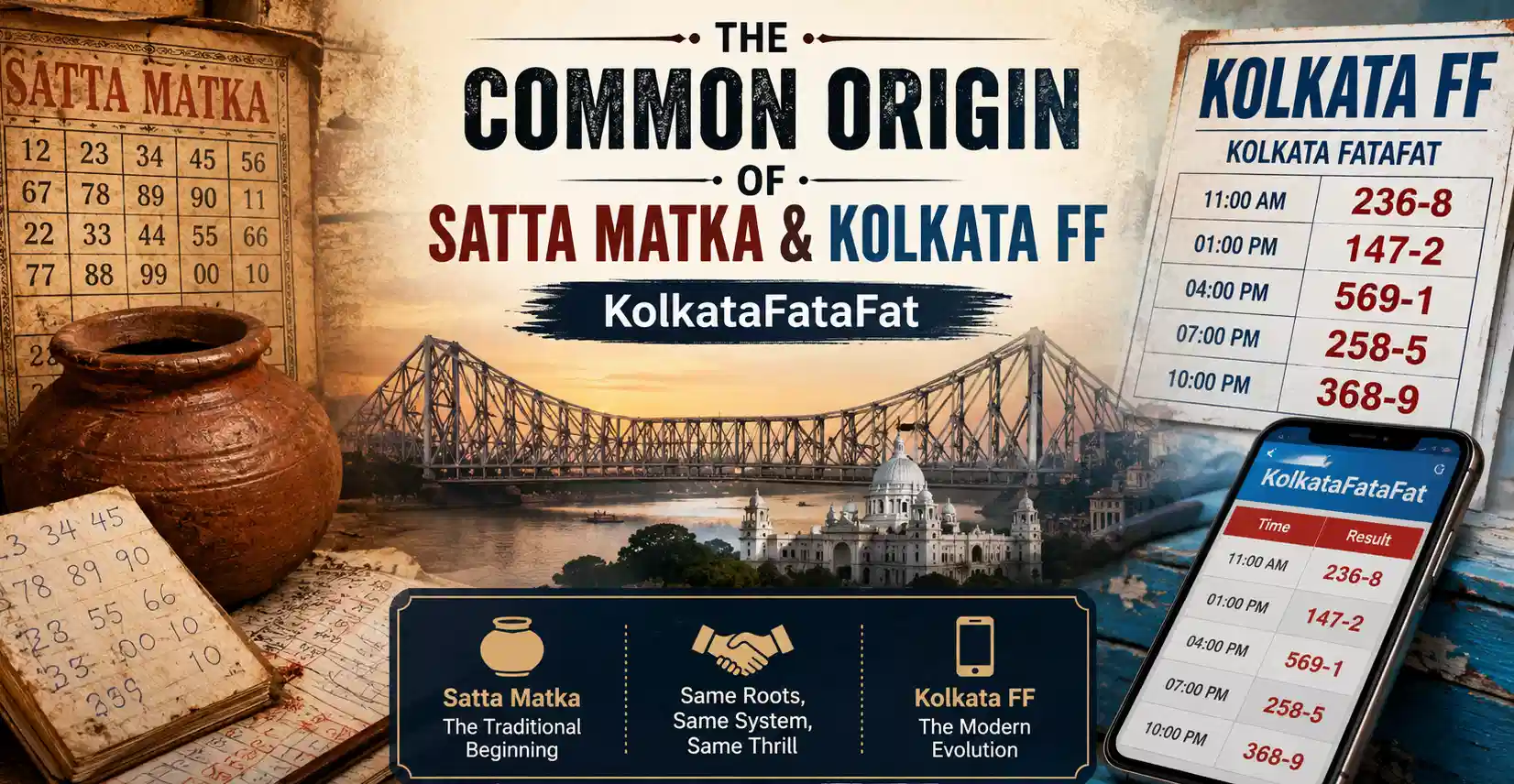
When you start learning some information about Fatafat from Kolkata, sooner or later you will see the word “Satta Matka”. And of course the first reaction of everybody is – they are different things. But it appears that there are lots of common things between them – common origin, history and so on. I will try to show how they are related.
Both of Them Are Number Games
Let’s recall what is the principle of Satta Matka and Kolkata FF: the player has to choose a certain number (either 0-9 or the three-digit combination) and win if it appeared in the end result. And everything is exactly the same. Some small differences of names and times of drawings do not matter much. Such similarity cannot arise accidentally – it is connected with the common history which goes back to the times far before these games got online.
The History of Cotton Exchange Is Connected with Matka
Everybody knows when Satta Matka appeared officially – in 1960s in Bombay. It was originally connected with the guessing whether the rates on the opening and closing of the rates of the New York Cotton Exchange to the Bombay Cotton Exchange would go up or down. After that exchange stopped sending these rates in 1961, the operators needed to change something and this version appeared.
The Transition from Writing Numbers to Pot
Now let us recall the etymology of the name “Matka”: it means the earthen pitcher in Hindi. Kalyanji Bhagat and then Ratan Khatri (also known as the Matka King) used to write numbers on the pieces of paper and put them into the earthen pot. After that the operator chose one of them and the number was appeared became the winning one. They used to play at the beginning with three cards of the playing deck, but the idea was the same. By the 1980s and 1990s Matka became widespread underground business which brought several crores per month.
Kolkata Adopted the Format and Accelerated It
Now moving forward in the 1970s, we can say that this format quietly came to the east and appeared in Kolkata. The operators in Kolkata liked it, but they thought that the time interval between the drawings was too long (maybe, Bengalis like the fast entertainment). So they raised the number of drawings per day to 8 (they occurred every 90 minutes), and called this game “Fatafat” (the meaning of the word “fatafat” is “fast”). One mother, different attitude.
Digit-Sum Feature Unites the Two
One of the main features of Satta Matka and Kolkata FF is the digit-sum feature. In the original Satta Matka it was necessary to choose three digits, calculate their sum and pay attention to the last digit of this sum (this one was considered as the “open” or “close” number). In the Kolkata FF the Patti with three digits is chosen, its digits are summed and reduced to one (and put near the slash mark). Exactly the same thing, only different terminology.
Legal Aspect of the Game: Not Quite the Same
But this is not the end of the story. Satta Matka is considered to be officially illegal in most Indian states according to the Public Gambling Act of 1867. Kolkata Fatafat is played in the grey zone of legality in West Bengal, because it is not organized by the state, but privately. These games are not the official state lotteries and can exist thanks to the tolerance of the locals.
Conclusion
Summing up all that was said above, we may conclude that Satta Matka and Kolkata FF are almost cousins from the same family tree. Their ancestors are the game with the earthen pitchers which appeared in 1960s Bombay. Their descendants are Kolkata Fatafat, Kalyan Matka, Milan Day and many other similar games. If anybody thinks that they are completely different things, he/she should know the real history of these games.
